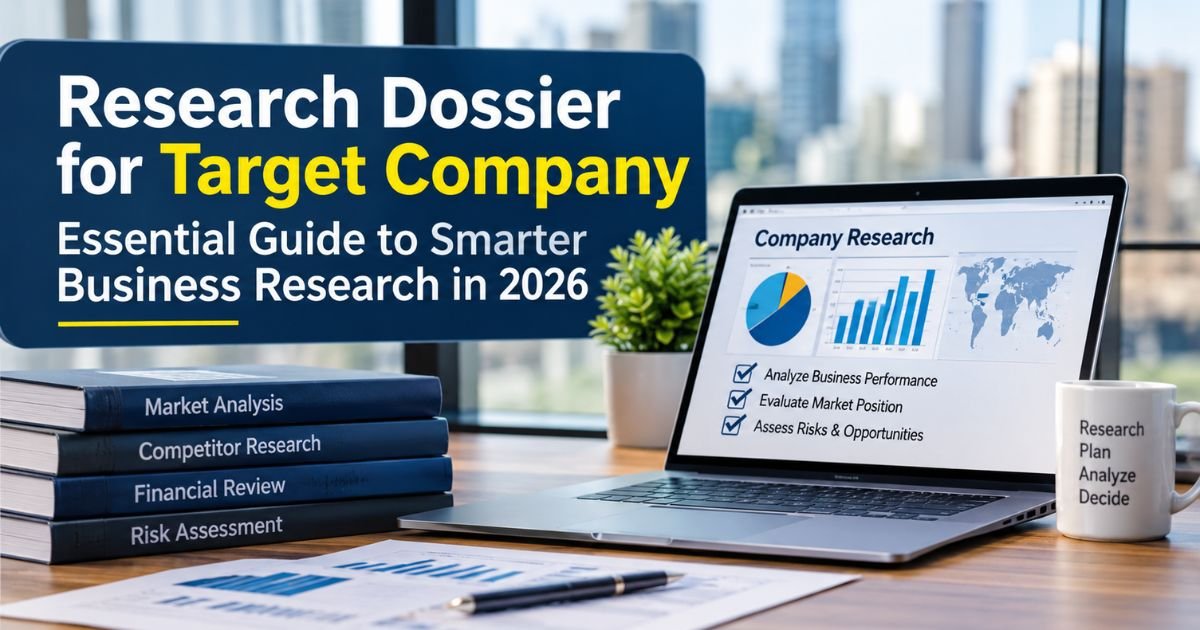
Research Dossier for Target Company: Essential Guide to Smarter Business Research in 2026
A research dossier for target company is a structured, sourced file about one organization, built to support a specific decision. That decision might be whether to pitch a prospect, sign a supplier, back a startup, pursue a partnership, or accept a job offer. A good dossier records who the company is, who owns and runs it, how it makes money, how stable it looks, what people say about it, and what you could not confirm.
This guide covers what belongs in a dossier, where to find reliable records in the US, the UK, and elsewhere, how to build one step by step, and how to use AI without being misled by it. It also includes a fillable template with a fictional worked example and a prompt you can copy. A dossier prepares you for expert advice. It does not replace legal, financial, or compliance review on high-stakes deals.
What Is a Research Dossier for a Target Company?
A research dossier is a decision-focused company research report. It collects facts about one organization, shows where each fact came from and when, and states how confident you are in it. The “target” is simply the company you are evaluating: a sales prospect, a supplier, an acquisition or investment candidate, a competitor, or a prospective employer.
Four features set a dossier apart from a pile of notes:
- It serves a decision. The objective shapes what you include.
- It is sourced and dated. Every key fact can be traced.
- It separates fact from inference. Estimates, claims, and gaps are labeled.
- It ends with a recommendation. That could be to proceed, pause, or dig deeper.
The next two sections explain how a dossier differs from similar documents and where it gets used.
Research Dossier vs. Company Profile vs. Due Diligence
These three terms overlap, and people often use them interchangeably. They describe different things.
| Company profile | Research dossier | Due diligence | |
| What it is | A short snapshot | A structured, evidence-based research file | A formal verification process |
| Typical contents | Name, location, size, products | Background, ownership, finances, market, reputation, legal checks, risks | Detailed financial, legal, tax, commercial, and operational review |
| Evidence standard | Often unsourced | Sources, dates, and confidence labels | Documents, often including non-public records provided by the company |
| Who usually does it | Anyone | Analysts, sales teams, consultants, founders | Specialists such as lawyers and accountants, plus deal teams |
| Leads to | General awareness | A specific decision or next step | A contractual or investment commitment |
A profile tells you what a company is. A dossier helps you decide what to do about it. Due diligence is the deeper, usually professional, verification that may follow, and it can draw on non-public documents that a dossier built from public information cannot reach. A dossier can feed into due diligence by showing which questions deserve expert attention. It does not replace it.
Common Business Use Cases for Company Research
The same method applies in every scenario. Depth and emphasis change with the stakes.
- Sales prospecting: Understand the buyer’s priorities, structure, and recent changes so your outreach is relevant. Leadership, news, and technology signals matter most.
- Supplier or vendor checks: Assess stability, compliance, and dependence on key customers before you rely on them. Financials, legal records, and reputation matter most.
- Investment screening: Decide whether a company merits deeper review. Financials, ownership, governance, and risks carry the weight.
- Partnership or acquisition screening: Check strategic fit and red flags before formal talks. Ownership, legal exposure, and market position matter most.
- Competitor study: Understand how rivals position, price, and expand.
- Interview preparation: Learn what a prospective employer does, how it is doing, and what questions to ask.
A short outreach brief might take a couple of pages. A pre-deal assessment can run far longer. Match the effort to what is at risk.
Read More About : TheJavaSea.me Leaks AIO-TLP371: Risks, Safety Guide, and Removal Options
Why Is a Target Company Research Dossier Important?
A company’s own website is a curated story. It is useful, but it is written to persuade. Independent research tests that story against registry records, court filings, news coverage, customer feedback, and the company’s own numbers. Sometimes it confirms the pitch. Sometimes it reveals thin finances, unclear ownership, or a pattern of complaints the marketing never mentions.
A shared dossier also gives a team one set of facts. Sales, finance, and legal can work from the same dated, sourced record instead of from scattered notes and memory. When the facts change, the record changes in one place.
Benefits for Business Intelligence and Decision-Making
Structured business intelligence research tends to help in a few practical ways:
- Earlier risk spotting. Problems such as unexplained ownership changes or missing filings are easier to catch before a commitment than after.
- Better negotiation preparation. Knowing a counterparty’s position, customers, and pressures informs pricing and terms.
- Consistency across a team. Everyone references the same facts and the same confidence levels.
- Faster onboarding. A colleague taking over an account or deal can get up to speed from the file.
- A documented decision trail. You can show later what you knew, when, and from which sources.
Consider a hypothetical example. A buyer plans a long contract with a young software vendor. The dossier shows the vendor has filed no accounts that can be checked, its funding history is unclear, and several engineering roles have recently been advertised again. None of this proves the vendor will fail. But it is enough to ask for a short pilot, a financial reference, or an escrow arrangement before committing to a multi-year deal. That is the value of a dossier: it turns vague unease into specific questions.
How AI Improves Company Research
AI tools are useful at the front end of research and the drafting stage. Used well, they can:
- Summarize long annual reports, filings, and news archives
- Pull key figures into a consistent template
- Compare competitors against the same set of criteria
- Draft a first version of each section
- Suggest gaps and follow-up questions you may not have considered
The pattern that works is AI drafts, humans verify. AI saves time on reading and organizing. It does not make the judgment call about what matters or whether a claim is true.
AI Research Limitations and the Need for Human Verification
The same tools can fail in ways that are easy to miss because the output sounds confident:
- Entity confusion. Companies with similar names, or a subsidiary and its parent, may be blended into one.
- Stale or undated data. Old figures may be presented as current.
- Fabricated or misattributed citations. A source may not exist, or may not say what the tool claims.
- Unsupported precision. Estimates may appear as exact figures.
- Thin private-company data. Where little is public, a tool may fill the gap with plausible-sounding guesses.
The working rule is simple: nothing enters the dossier unless you have traced it to a source you opened yourself. The verification procedure appears later in this guide.
Read More About : Thealite Keep Safe Guide: What the Website Is, Content, Safety, and Privacy (2026)
Essential Components of a Company Research Dossier
A complete dossier has twelve components. Each answers a different question, and together they give a full picture of the business.
| Component | The question it answers |
| Company identity, background, and business model | Who is this, and how does it make money? |
| Leadership, ownership, and structure | Who runs it, and who controls it? |
| Products, services, customers, and markets | What does it sell, and to whom? |
| Financial performance, funding, and stability | Is it financially sound? |
| Market position and competitors | Where does it stand against rivals? |
| Geographic footprint | Where does it operate and where is it registered? |
| Hiring, growth signals, and news | Which direction is it moving? |
| Reputation and public perception | What do customers and others say? |
| Legal, regulatory, and compliance | Is there legal or regulatory exposure? |
| Technology and intellectual property | Do its technology claims hold up? |
| Risks, red flags, and opportunities | What could go wrong or right? |
| Executive summary and next steps | What should we do, and what remains unknown? |
You do not need every component at full depth every time. A sales brief might need five or six. A pre-acquisition review needs all twelve. Scale the depth to the decision.
Each component below covers what to record and what a warning sign looks like. Where to find the information is covered in the sources section that follows.
Company Identity, Background, and Business Model
This component answers who the company actually is, and it is where most entity mix-ups are prevented. Record:
- Legal name and any trading names
- Registration number and jurisdiction
- Registered address and headquarters
- Date of incorporation or founding
- Parent company and subsidiaries
- Industry and what the company does
- Business model: who pays, for what, and how often (subscriptions, transactions, services, advertising, licensing)
Company background research also covers the main customers and the problem the company says it solves. A warning sign is a mismatch between the name on the website, the name on the contract, and the name on the registry.
Leadership, Ownership, and Organizational Structure
Understanding the company ownership structure tells you who has real influence. Record the CEO, founders, board members, senior managers, and their prior roles, along with any recent departures. Then look at ownership: major shareholders, parent companies, and where possible the people who ultimately benefit from or control the company, often called beneficial owners.
How much ownership information is public depends on the country and the company type. UK companies have a register of people with significant control maintained through Companies House. Public companies in the US disclose major shareholders and executive information in their filings, such as proxy statements. For private companies in many places, ownership may be only partly visible. Treat that as a finding in its own right rather than assuming nothing is hidden.
Key-person dependence also belongs here. If the business relies heavily on one founder or one contract, note it.
Products, Services, Customers, and Target Markets
Record what the company sells, how it prices it, which customer segments it serves, and which customers it names. Then separate what you have confirmed from what the company merely says.
A claim and its evidence are not the same thing:
- Claim: “Trusted by leading enterprises.” Evidence: named customers confirmed through case studies, press coverage, or the customers’ own statements.
- Claim: “Industry-leading accuracy.” Evidence: independent testing, certifications, or published benchmarks.
Customer logos and testimonials on a company site are a starting point for questions, not proof.
Read More About : 33+ Results SFFareBoxing SportsFanFare Complete Guide to Boxing Results Scores and Fighter Records
Financial Performance, Funding, and Business Stability for Public vs. Private Companies
Company financial analysis looks very different depending on whether the target is public or private. Whichever applies, record the reporting period and currency for every number, and write “undisclosed” rather than “zero” when data is missing.
Public companies publish detailed reports. US-listed companies file annual reports (Form 10-K), quarterly reports (Form 10-Q), and event-driven reports (Form 8-K) with the SEC. Foreign private issuers listed in the US file different forms, such as Form 20-F. Look at multiyear trends in revenue, margins, cash flow, and debt. Rising revenue means little if costs and debt rise faster.
Private companies disclose far less, and the rules differ by country. This is the common real-world challenge when researching a business with limited public information. Places to look include:
- Statutory accounts, where required. UK companies must file annual accounts with Companies House, though smaller companies may file abridged versions with limited detail.
- Funding announcements and press releases. Treat amounts and valuations from press coverage as reported, not verified.
- Security and lien records. In the UK, registered charges appear on the Companies House record. In the US, lien filings are generally held at state level.
- Court records and credit-related filings. These may indicate unpaid debts or disputes.
- Third-party estimates. Revenue and headcount estimates from data providers can be useful context but should always be labeled as estimates.
| Usually available | Often unavailable | |
| Public company | Audited statements, segment data, risk disclosures, executive pay, major shareholders | Internal forecasts, contracts not disclosed as material |
| Private company | Registration details, some filed accounts (country-dependent), funding news, court records | Detailed financials, customer concentration, internal projections |
Whatever the target, run a short sanity check:
- Is revenue growth outpacing cost growth?
- Does the company have enough cash for its obligations?
- How heavy is its debt relative to its earnings?
- Does a handful of customers account for most of the income?
- Have the accounts been audited, and by whom?
Audited statements carry more weight than unaudited management figures, but even audited numbers describe the past and are prepared by the company. If data is missing, record the gap and its implications rather than guessing.
Market Position, Industry Trends, and Competitor Analysis
Industry analysis puts the company’s numbers in context. Define the market the company actually competes in. Then identify direct competitors (similar product, same customers) and indirect ones (different approach to the same problem).
A fair competitor analysis compares everyone on the same criteria: offering, pricing, customer type, regions, and visible strengths and weaknesses. This shows where the target wins and where it faces pressure.
Handle market-share figures with care. Always record who produced the estimate, for which year, and how it was calculated. Industry-trend claims need a source and a date as well.
Geographic Footprint and Key Business Markets
Record where the company is registered, where it operates, where its customers are, and where its subsidiaries and branches sit. Geography matters because different countries have different regulators, disclosure rules, and legal risks. A company registered in one jurisdiction may do most of its business in another, and the subsidiary you are contracting with may be a different legal entity from the brand you know.
For each country involved, identify the relevant registry. Cross-border entity matching is hard, so check whether the company has a Legal Entity Identifier (LEI), a global code used mainly by financial-market participants. Many private companies will not have one.
Read More About : BD268 XZ Explained Meaning, Uses, Benefits, and Future in Digital Systems
Hiring Activity, Growth Signals, and Recent News
Job postings, leadership changes, partnerships, launches, funding rounds, layoffs, and restructuring all hint at direction. These are signals, not proof. A cluster of data-science roles may suggest a new product push, or it may reflect routine turnover. Reposted roles may indicate retention problems, or just an evergreen recruiting pipeline.
Record what you see, the date, and the likely interpretations, including the benign ones. Because job postings disappear, save dated captures of anything you rely on.
Reputation, Customer Reviews, and Public Perception
Reputation research asks what customers, employees, partners, and regulators say, and how the company responds. Useful inputs include customer review platforms, employee review sites, press coverage, and, where available, regulator complaint databases. Which databases exist depends on the country and industry, so check what applies.
Read for patterns, not anecdotes:
- Weak signal: one angry review, an undated post, an unverifiable claim.
- Stronger signal: the same complaint recurring across multiple platforms and time periods, regulator actions, consistent employee comments about the same issue.
Also note how the company responds. Specific, timely fixes tell you something different from silence or boilerplate. Do not label reviews as fake without evidence, and add dates and sources to every finding.
Legal, Regulatory, and Compliance Risks
Legal checks protect you from surprises, and they start with having the correct legal entity. Look at:
- Licenses and registrations the business needs to operate
- Litigation records
- Regulatory enforcement actions
- Sanctions screening, using official lists such as those published by US, UK, EU, and UN authorities
- Adverse media, meaning credible reporting of misconduct or investigation
Three rules apply. First, an allegation is not a finding; record what is actually established. Second, “no record found” does not mean “clean,” because records may be incomplete, under a different name, or in a jurisdiction you did not search. Third, anything high-stakes belongs with qualified legal or compliance professionals. Access to court records and the rules on sanctions vary by country, so treat this section as a research checklist, not legal advice.
Read More About : BackToFrontShow Pricing 2026: Plans, Costs, Features & Honest Review
Technology, Intellectual Property, Patents, and Trademarks
For technology-driven companies, check whether the technical claims are backed by something concrete. Record the visible technology stack where it is disclosed, patents and pending applications, trademarks, and any notable open-source dependencies or licensing.
A few distinctions matter. A patent application is not a granted patent. A patent held by a founder or a previous owner may not belong to the company. And a patent portfolio does not prove commercial success. For most non-technical targets, this component can be brief. For a deep-tech or software company, it deserves real attention.
Business Risks, Red Flags, and Growth Opportunities
This is where findings become a company risk assessment. Group risks by type, tie each to evidence, and rate them on two dimensions: how serious the issue would be (severity) and how sure you are it is real (confidence). The rating approach is a practical suggestion, not an industry standard.
| Risk type | Example red flag | Evidence to check |
| Financial | Revenue flat while debt rises | Filed accounts, funding history |
| Ownership and governance | Unexplained changes in control, opaque ownership chains | Registry records, ownership filings |
| Legal and compliance | Repeated regulatory actions or unresolved litigation | Court and regulator records |
| Operational | Heavy dependence on one customer or one supplier | Filings, customer disclosures |
| Reputational | The same complaint recurring across sources | Dated review and news patterns |
| Key-person | Business rests on one founder | Leadership records, news |
| Transparency | Required filings missing or consistently late | Registry filing history |
Balance the risks with opportunities: new markets, strong technology, improving margins, or partnerships. A dossier that only lists problems is as unhelpful as one that only lists positives.
Executive Summary, Evidence Gaps, and Recommended Next Steps
The executive summary is the page a busy reader will actually use. It should stand on its own and contain:
- The objective of the research
- Three to five key findings
- The main risks and opportunities
- Evidence gaps: what you could not verify
- A recommended action: proceed, pause, or dig deeper
- The report date
Label findings with a confidence level. A simple scale, which is our suggestion rather than a standard, works like this:
| Confidence | Meaning |
| High | Confirmed by an official or primary source and corroborated by a second independent source |
| Medium | Supported by one reliable source |
| Low | Unverified, inferred, or based on a weak or conflicting source |
Listing evidence gaps openly is a strength, not a weakness. It tells the reader exactly where further checking is needed.
Read More About : AllysPlay.com Explained: Features, Game Content, Safety, and Complete Guide (2026)
Best Sources for Target Company Research
Strong research combines primary sources (records and documents produced by the company or an official body) with secondary sources (reporting, analysis, and opinion about the company). Neither is perfect. Even official filings are typically prepared by the company, and independent coverage can be incomplete or wrong. Cross-checking is what makes the picture reliable.
| Source type | Best for | Main limitation |
| Official registries and regulatory filings | Legal status, officers, filed accounts, public-company disclosures | Coverage and detail vary by country and company size |
| Company website and reports | Official claims, strategy, products | One-sided and unaudited in many cases |
| Reputable news and trade press | Events, context, industry trends | May be incomplete, dated, or sponsored |
| Job boards and careers pages | Growth and hiring signals | Postings can be stale or evergreen |
| Patent and trademark databases | Technology and brand protection | Ownership and status need careful reading |
| Reviews, forums, and social media | Public sentiment and questions to investigate | Noisy, biased, and sometimes manipulated |
Official Company Websites and Investor Relations Pages
Start with the company’s own materials, treating everything as claims to test. Useful items include annual reports, investor presentations, press releases, leadership and board pages, product documentation, terms of service, privacy policies, and the careers page. The legal and terms pages often reveal the exact legal entity operating the service, along with its registered address, which helps with entity verification.
Business Registries and SEC EDGAR Filings
Corporate filings and business registries are the most authoritative starting point for identity, status, and finances. Coverage differs by jurisdiction:
| Jurisdiction | Source | What it typically offers |
| US (public companies) | SEC EDGAR company filings | Annual and quarterly reports, current reports, proxy statements, and ownership filings for companies that file with the SEC |
| US (private companies) | State registries, usually run by each state’s Secretary of State or equivalent | Entity status, registered agent, formation details; detail varies by state |
| UK | Companies House company search | Free search of company status, officers, filing history, filed accounts, registered charges, and people with significant control |
| Global | OpenCorporates | A searchable aggregator of company registry data from many jurisdictions; coverage and freshness vary, so confirm against the original registry |
| Global (financial) | GLEIF LEI search | Identifiers and basic ownership links for entities that have an LEI |
For each record, note what it does not tell you. EDGAR covers companies that file with the SEC, not private firms. Companies House holds what companies are required to file, which may be limited for small companies. Registry rules, access methods, and requirements change over time, so check each registry’s current guidance, including any rules for automated access, before building a process around it.
Reputable News Outlets and Industry Publications
Use news and trade press for context and events that records do not capture. Check the publication date every time. Read more than one outlet on significant stories. Distinguish reporting from opinion and from sponsored content. For anything that matters, trace the claim back to its original source rather than relying on an article that repeats it.
Job Postings, Hiring Announcements, and Company Updates
Careers pages and job boards show which functions and locations the company is investing in. Save dated captures, since postings disappear. Remember that postings may be stale or perpetual. Check each platform’s terms of use before collecting data at scale, and avoid automated scraping that the terms prohibit.
USPTO, Google Patents, and Technology Research Sources
Search the US Patent and Trademark Office for US patents and trademarks, and Google Patents for broad patent search. For international coverage, options include Espacenet, WIPO’s PATENTSCOPE, and the UK Intellectual Property Office for UK filings. Search by assignee (the owner) as well as by inventor name, and confirm who currently owns each right. Interfaces change, so confirm which tool is current before documenting your process. Developer documentation and public code repositories can also reveal what a technology company actually builds.
Review Websites, Forums, and Social Media
Use these to generate questions, not to prove facts. Look for patterns across several platforms and time periods. Be aware of platform bias, outdated posts, and the possibility of manipulated reviews. A post from a single person is not a statement from the company, and an unverified claim should stay out of the final file unless corroborated.
How to Evaluate Source Credibility and Reliability
Before relying on any source, run it through five checks:
- Who produced it? Identify the author or organization and their expertise.
- When was it published or updated? Old data may no longer apply.
- Is it primary or secondary? Prefer the original document over a summary of it.
- Does the source have a stake? A company’s marketing page and a competitor’s blog both have incentives.
- Does another independent source agree? Corroboration matters most for decision-critical claims.
A source that fails these checks should stay out of the final file, or appear only with a low-confidence label. When sources disagree, record both and explain which you relied on and why.
Read More About : GrammarVista.com USA: Features, Grammar Tools, and American English Guide
How to Build a Research Dossier for a Target Company
This company research methodology has eight steps. The process is the same whether you are producing a two-page sales brief or a deep pre-deal assessment. Only the depth changes.
- Define the research objective.
- Identify and verify the legal entity.
- Create a standardized research outline.
- Collect information from reliable sources.
- Record sources, evidence, dates, and confidence levels.
- Verify facts and cross-check important claims.
- Analyze findings, risks, and opportunities.
- Prepare the final report and update schedule.
Step 1: Define the Research Objective
Write the decision the dossier must support in one sentence, then list three to five questions it must answer. Set the depth, any deadline, and any constraints such as confidentiality.
Example objective (sales): “Decide whether this prospect is a good fit for our product and who to approach first.” Questions: What does it do, who leads the relevant function, has anything changed recently, and what does its technology stack suggest?
Example objective (supplier): “Decide whether this supplier is stable enough for a three-year contract.” Questions: Who owns it, are its accounts filed, is there litigation, and how dependent is it on a few customers?
Step 2: Identify and Verify the Target Company’s Legal Entity
Confirm exactly which company you mean before you collect anything else. Match these details across sources:
- Legal name, including suffix (Ltd, Inc., LLC, GmbH)
- Country or state of registration
- Registration number
- Registered address
- Website domain and the entity named in its terms and conditions
- Parent company and subsidiaries
If the details do not line up, stop and resolve the mismatch. For example, a brand operating in several countries may contract through a different local company in each. Researching the wrong entity can invalidate everything that follows.
Step 3: Create a Standardized Research Outline
Decide which of the twelve components you need and how deep each should go. A fixed layout makes it easy to compare several targets fairly and saves time on future projects. The template later in this guide provides a ready structure. Mark components as core or optional based on your objective.
Step 4: Collect Information from Reliable Sources
Start with official records, then add independent sources, then company materials. Keep company-sourced and outside-sourced information separate. For private targets, expect gaps and plan to document them.
A note on ethics and privacy: stick to publicly available information, and do not misrepresent who you are to obtain it. Respect website terms of use and confidentiality obligations. Be careful with personal data about individuals, since privacy and data-protection laws such as GDPR, UK GDPR, and various US state laws may apply. When the work is sensitive or high-stakes, check with counsel.
Step 5: Record Sources, Evidence, Dates, and Confidence Levels
An evidence log lets anyone retrace your steps and makes later updates much easier. For every finding, record:
| Field | Example (fictional) |
| Claim | Company reports annual revenue of $12.4M |
| Source and link | Company annual report, URL saved |
| Date published | March 2026 |
| Date accessed | November 2026 |
| Reporting period and currency | Year ended Dec 2025, USD |
| Confidence | Medium (one source, unaudited) |
Use the confidence scale defined in the executive summary component. Save screenshots or archived copies of anything likely to change, such as job postings, pricing pages, or leadership pages.
Step 6: Verify Facts and Cross-Check Important Claims
Not every fact needs the same scrutiny. Identify the decision-critical claims, meaning the ones that would change your recommendation if wrong, and confirm each with a second independent source.
When sources conflict, record both figures, explain the likely reason, and lower your confidence. For example, suppose a news article says a company has 500 employees and its own site says 300. The difference might come from contractors, a different date, or inflation in one source. Record both numbers, note the discrepancy, and avoid choosing the more flattering one without a reason. If a claim cannot be confirmed, either leave it out or include it with a low-confidence label.
Step 7: Analyze Findings, Risks, and Opportunities
Now ask what the facts mean for your objective. Tie each finding to the decision. Separate what is established from what you are inferring, and label inferences as such. Consider alternative explanations before settling on one, and watch for confirmation bias: looking harder for evidence that supports your first impression.
Useful questions:
- Which findings would change the recommendation if they turned out to be wrong?
- What is missing, and does the gap itself signal risk?
- Which risks are severe but low-confidence, and worth further checking?
- Which strengths are verified versus claimed?
A SWOT-style summary can help organize this, but it is one lens among many rather than a required format.
Step 8: Prepare the Final Report and Update Schedule
Lead with the executive summary, then findings, risks, recommendations, and sources. Date the report and note its version. Choose the output to suit the audience: a one-page brief for a sales call, a memo for a manager, slides for a committee.
Then decide how often to refresh the file. This is a matter of judgment. Fast-moving companies, or deals with an approaching deadline, deserve more frequent checks. Specific events should trigger an update as well, such as a leadership change, a funding round, litigation, or news of a restructuring.
Read More About : TechTrendery.Com USA Complete Guide to Features Topics Safety And Credibility 2026
How to Create a Target Company Research Dossier Using AI
AI-powered company research works best as a way to speed up collection, drafting, and pattern-spotting, with a person responsible for verification and judgment. Tools and their features change quickly, so check current capabilities and policies before relying on any one of them.
Choose the Right AI Research Tools
Rather than start from a product name, start from what you need:
- Visible sources. Does the tool provide links you can open and check?
- Current data. Can it access recent information, or only its training data?
- Document handling. Can it work from filings and reports you supply?
- Data privacy and retention. What happens to what you upload or type?
- Cost and export options. Can you get results into your template?
General-purpose AI assistants and specialist financial-data or business-information platforms play different roles. The first is flexible for drafting and summarizing; the second typically offers structured data from specific providers. Do not paste confidential, non-public, or personal information into any tool without checking the provider’s terms and your organization’s policy.
Generate the Dossier Section by Section
Asking for everything at once produces long, uneven output that is hard to check. Work one section at a time instead:
- Supply the verified legal entity details from Step 2.
- Provide the template heading for the section you want.
- Ask for sources with links and dates for each key fact.
- Instruct the tool to write “unavailable” rather than guess.
- Review the output, then move to the next section.
A single request might read: “For [legal entity, country], summarize the leadership team using only sources you can link to, and mark anything you cannot verify as unavailable.” A full reusable prompt appears later in this guide.
Verify AI-Generated Facts and Citations
Treat the draft as unverified until you have checked it. For each key fact:
- Open every link and confirm the page exists.
- Confirm the page actually says what the tool claims.
- Match figures to the original filing or record, including the period and currency.
- Confirm the source is about the right legal entity.
- Check the publication date.
- Delete anything you cannot confirm.
Warning signs include broken or generic links, citations with no date, numbers with no reporting period, and facts that appear in no source you can find.
Use AI to Identify Patterns, Risks, and Business Opportunities
Once the facts are verified, AI can help you reason about them: comparing several years of figures, grouping recurring themes in complaints, summarizing differences between competitors, or proposing hypotheses to test. Questions you might ask:
- “What changed in revenue and costs across these five years of filings?”
- “What themes recur in these customer complaints?”
- “How do these three competitors differ on price, region, and customer type?”
Treat every AI-suggested risk or opportunity as a hypothesis until you have tested it against evidence. Only evidence-backed items belong in the final dossier.
Read More About : Deshoptec Com Review 2026 What It Is Is It Safe and How It Works
Research Dossier for Target Company Practical Template
Use this layout as a company research template, and adapt it to your objective. A light version for a sales brief might run two or three pages. A deep version for a major deal can be much longer. A longer report is not automatically a better one, so include only what supports the decision.
| Section | Fields to record |
| 1. Company identity, background, and business model | Legal name, trading names, registration number, jurisdiction, HQ, founding date, parent and subsidiaries, industry, revenue model |
| 2. Leadership, ownership, and structure | Executives, board, founders, major shareholders, beneficial owners, recent changes |
| 3. Products, services, customers, and markets | Offerings, pricing model, segments, named customers (verified), claims vs. evidence |
| 4. Financial performance, funding, and stability | Revenue, profit, cash flow, debt, funding rounds, auditor, reporting period, currency, estimate flag |
| 5. Market position and competitors | Market definition, trends, competitor grid, sources for any share figures |
| 6. Geographic footprint | Countries of registration and operation, subsidiaries, regulators |
| 7. Hiring, growth signals, and news | Dated postings, leadership moves, partnerships, launches, restructuring |
| 8. Reputation and public perception | Review patterns, complaint data, press tone, company responses |
| 9. Legal, regulatory, and compliance | Licenses, litigation, regulatory actions, sanctions screening result, adverse media |
| 10. Technology and IP | Tech stack, patents (granted vs. pending), trademarks, open-source use |
| 11. Risks, red flags, and opportunities | Risk, category, evidence, confidence, severity |
| 12. Executive summary and next steps | Objective, key findings, gaps, recommendation, review date |
The examples below use a fictional company, “Brightharbor Freight Software, Inc.” All details and figures are invented for illustration and do not describe any real business.
Company Information and Business Overview
| Field | Fictional example |
| Legal name | Brightharbor Freight Software, Inc. |
| Registration | Delaware, USA; number on file (illustrative) |
| Headquarters | Austin, Texas (illustrative) |
| Industry | Logistics software |
| Business model | Annual subscriptions for shipment-tracking software |
| Main customers | Mid-size freight forwarders |
| Source and confidence | State registry and company website; High for identity, Medium for customer claims |
Keep each entry short and sourced.
Financial, Market, and Competitive Analysis
| Field | Fictional example |
| Revenue | $12.4M, year ended Dec 2025, USD (illustrative; company-reported, unaudited) |
| Debt | Undisclosed |
| Funding | One seed round announced in press; amount reported, not verified |
| Estimate? | Yes, revenue and funding |
Competitor grid:
| Rival | Offering | Pricing | Region | Strength | Weakness |
| Rival A (fictional) | Tracking platform | Per-user | North America | Large customer base | Slower product updates |
| Rival B (fictional) | Tracking plus customs tools | Tiered | UK and EU | Regulatory features | Limited US coverage |
Risk Assessment and Key Findings
| Risk | Category | Evidence and source | Confidence | Severity | Open question |
| No audited accounts available | Financial | Company site, no filings found | Medium | High | Can the company share audited statements? |
| Two senior engineers recently left | Operational | Dated news and profile changes | Low | Medium | Who covers their work? |
Include a short strengths list alongside the register, such as a verified named customer or a granted patent.
Recommendations and Next Steps
| Field | Fictional example |
| Recommendation | Pause; request audited accounts before proceeding |
| Rationale | Financial stability cannot be verified, and the contract is multi-year |
| Open questions | Audited statements; ownership of core IP; customer references |
| Owner | Procurement lead |
| Review date | 30 days from report date |
Copy-and-Paste AI Prompt for a Company Research Dossier
Fill in the brackets, run the prompt one section at a time, and follow it with the verification steps above. Results vary by tool, and the output is a draft that needs checking.
Ready-to-Use Target Company Research Prompt
Act as a careful business research analyst. Build a research dossier on the company below.
COMPANY DETAILS
– Company name: [Company Name]
– Website: [URL]
– Country or state of registration: [Country/State]
– Registration number, if known: [Number or “unknown”]
MY GOAL
[Choose one: sales prospecting / supplier check / investment screening / partnership or acquisition screening / interview preparation]
BEFORE YOU START
Confirm which legal entity you are researching. List any similarly named companies, parents, or subsidiaries, and tell me if you are unsure which one is correct. Do not continue until the entity is confirmed.
WORK ONE SECTION AT A TIME, in this order:
1. Company identity, background, and business model
2. Leadership, ownership, and organizational structure
3. Products, services, customers, and target markets
4. Financial performance, funding, and stability
5. Market position and competitors
6. Geographic footprint
7. Hiring, growth signals, and recent news
8. Reputation and public perception
9. Legal, regulatory, and compliance
10. Technology and intellectual property
11. Risks, red flags, and opportunities
12. Executive summary and recommended next steps
RULES
– Use only reliable sources: official registries and filings, company reports, and reputable news or trade publications.
– For every key fact, give the source link and the date. Include the reporting period and currency for any financial figure.
– Label each finding High, Medium, or Low confidence. High means an official or primary source plus a second independent source. Medium means one reliable source. Low means unverified or inferred.
– If information is not available, write “unavailable”. Do not guess, and do not fill gaps with estimates unless you clearly label them as estimates and name the source.
– If sources conflict, show both and explain the difference.
– Do not treat an allegation as a proven violation.
– Keep company claims separate from independently verified facts.
FINISH WITH
A list of open questions and any claims I should verify myself before relying on this dossier.
Note: I will not share confidential or non-public information in this conversation.
Read More About : TheStripesBlog.com Contact Guide: Email, Phone, and Official Details In 2026
Common Mistakes to Avoid When Preparing a Company Dossier
Most dossier errors come from rushing or from leaning too heavily on a single source. This table works as a quick checklist.
| Mistake | Fix |
| Researching the wrong entity | Confirm legal name, jurisdiction, and registration number first (Step 2) |
| Relying on the company’s website alone | Add registry records and independent sources |
| Using data with no date or period | Log publication date, access date, and reporting period |
| Presenting estimates as facts | Label estimates and name who produced them |
| Treating “nothing found” as “no risk” | Record “unavailable” and note what you searched |
| Accepting AI output unchecked | Open every link and match figures to originals |
| Starting without a clear objective | Write the decision and key questions first |
| Hiding conflicts between sources | Record both figures and explain your choice |
| Padding the report | Keep only decision-relevant facts |
| Ignoring privacy and terms of use | Stick to public information and respect platform rules |
Who Should Use a Target Company Research Dossier?
Anyone who has to judge a business before acting can use one. The depth should match the stakes: a short brief for a routine outreach email, far more for a major commitment. The sections below describe what each group tends to emphasize.
Investors and Financial Analysts
Investors typically use dossiers to screen opportunities before formal review. The emphasis falls on financials, ownership, governance, and risk. A dossier is research, not investment advice, and it does not replace professional analysis. Be mindful of the boundary around material non-public information: base the file on publicly available sources.
Business Development and Sales Teams
Sales and business development teams use dossiers to understand a prospect’s goals, structure, technology, and recent news, and to identify the right contacts. Recent developments can make good, relevant conversation openers. Keep the focus on business context and avoid collecting personal information about individuals beyond what is relevant to their professional role.
Consultants, Researchers, and Entrepreneurs
Consultants turn dossiers into client deliverables. Researchers use them to keep evidence organized and traceable. Entrepreneurs use them to study competitors and test new markets. A consistent format makes it fair to compare several companies side by side, and job seekers can use a short version to prepare for interviews.
Read More About : 55+ MiloMagazine.co.uk USA Website Review: Content, Credibility, and SEO Opportunities
Frequently Asked Questions
What Is a Research Dossier for a Target Company?
It is a sourced, dated file about one organization, compiled to support a specific decision such as a sale, purchase, partnership, or investment review. It brings together background, ownership, finances, market position, reputation, and risks, and flags what could not be verified.
What Should a Company Research Dossier Include?
At minimum: identity and business model, leadership and ownership, products and customers, financials, market and competitors, geographic footprint, hiring and news signals, reputation, legal checks, technology and IP, risks and opportunities, and an executive summary with evidence gaps and next steps. Include only what the decision requires.
How Do You Prepare a Research Dossier on a Company?
Define the decision you need to support, confirm the legal entity, and choose a standard outline. Then collect information from official and independent sources, log each source with its date, and cross-check the important claims. Finally, analyze the findings, write the summary, and date the report.
What Is the Difference Between a Company Profile and a Research Dossier?
A profile is a quick snapshot of basic facts. A dossier goes further: it is built for a decision, backed by dated sources, and includes risks, confidence levels, and recommended actions.
How Do You Research a Private Company?
Start with the company registry for its jurisdiction and any filings it is required to make. Add funding announcements, court and lien records, trade press, and customer or employee feedback. Label estimates clearly, and record what is unavailable. Expect gaps, and treat a lack of transparency as a finding worth noting.
Can AI Create a Reliable Company Research Dossier?
AI can speed up collecting and drafting, but reliability depends on verification. Tools can confuse similarly named companies, use outdated figures, or cite sources that do not support their claims. A dossier is reliable when a person has checked each key fact against an original source.
Conclusion
A research dossier turns scattered information into a usable decision. The method comes down to a few habits: state the decision you are supporting, confirm you have the right legal entity, rely on records before claims, verify what matters, label your confidence, and note what you could not find. AI can make the drafting faster, but the checking remains your job.
To start, copy the template or the prompt above and begin with Step 1. Write your decision in a single sentence, and let that sentence determine how deep the rest of the research needs to go.