
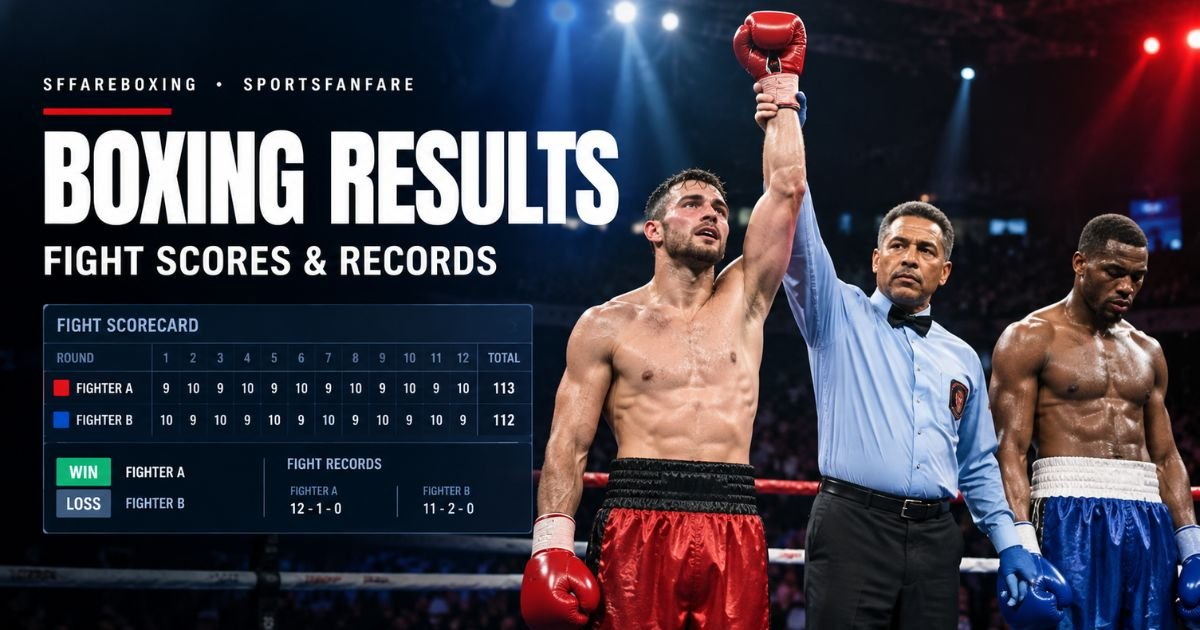
33+ Results SFFareBoxing SportsFanFare Complete Guide to Boxing Results Scores and Fighter Records
If you searched for “Results SFFareBoxing SportsFanFare,” you’re probably after a fight result, or you want to know what this name is. Here’s the short version. The phrase turns up in third-party articles about boxing results and schedules, but when this article was prepared (late October 2026), I couldn’t find an official SFFareBoxing or SportsFanFare website, an owner, or a stated data source. So treat any result you see under that name as unconfirmed until you’ve checked it against an official or widely used reference.
This guide covers what we could and couldn’t establish about the name, how to find a result no matter where it’s published, how to read result lines and scorecards, and how to confirm that a result is official. If you only need a winner right now, jump to the verification steps further down.
What Is Results SFFareBoxing SportsFanFare?
The phrase combines a site-style name, SFFareBoxing, with SportsFanFare and the word “results.” People use it like a brand name: “SFFareBoxing boxing results” or “SportsFanFare boxing results.”
Here’s what a search turned up. A guide on tycoonstory.com describes “SFFareboxing schedules by SportsFanfare” as a search topic for fans following upcoming fights, event dates, venues, and broadcast updates. But it defines the name only as schedule information connected with “SportsFanfare-style sports coverage.” That doesn’t point to a specific company, site, or data source.
Searching the name also brings up unrelated pages about transit fareboxes, which is simply noise from the word “fare.”
| Question | Status |
| Does the phrase appear in third-party boxing content? | Confirmed |
| Is there an official site or “about” page we could identify? | Not confirmed |
| Who owns or runs it? | Not confirmed |
| Where its results data comes from | Not confirmed |
| Whether it offers live scores, fighter pages, or rankings | Not confirmed |
None of this means the name is a scam, and none of it means it’s trustworthy. It means the available evidence doesn’t say. That could change, so if you’re reading this well after October 2026, run your own search first.
For results you can rely on, use the sources covered in the verification section below. The next sections explain how to find and read any boxing result, whatever site shows it.
How to Find the Latest SFFareBoxing Boxing Results
Finding the latest boxing results comes down to three starting points: a fighter, an event, or a date. Once you’ve found a result, confirm it with a promoter page, a commission release, or a record database such as BoxRec. Searches work best when you search for the fight itself rather than for any one site’s name.
Search for Results by Fighter Name
Use the fighter’s full name, including suffixes like “Jr.” and any alternate spellings, since many boxers share surnames and some names are transliterated differently. Add “record” to see a full career list or “results” to see the latest bouts.
A few things help:
- Check the weight division and country on the profile to make sure it’s the right person.
- Beware of nickname-only searches, which often return fan pages rather than records.
- Open the fighter’s database page, then confirm the newest entry against the promoter or the fighter’s official channels.
Check Fight Dates, Opponents, and Events
If you remember a date or an opponent but not the name you need, work from those. Searching by opponent gives you a second route to the same bout, and the event page shows the whole card, which helps if you only half-remember who fought.
When several events share a similar name, venue and city separate them. And remember that a fight on a Saturday night in Las Vegas can land on Sunday in the UK or Asia, so the date you remember may not match the date listed.
Find Recent Results and Record Updates
Sort a fighter’s list by date and look at the most recent entry first. Then check whether it’s the latest, since a very new result may not be posted yet. A page that shows no recent bout isn’t necessarily wrong. It may simply be behind.
What to Do When a Boxing Result Is Missing or Delayed
- Confirm the fight happened. Postponements, cancellations, and opponent changes are common. The fight-schedule section below covers how to check.
- Give databases some time. Entries are often added after the event, and small or regional shows may take longer to appear.
- Check the promoter and the broadcaster. Their event pages and social channels often carry the result first.
- Look for a commission or governing-body release, especially for sanctioned professional bouts.
- Treat unverified social posts carefully. Early posts can get the method or the score wrong.
- If sources disagree, wait. The official release settles it.
Read More About : 55+ MiloMagazine.co.uk USA Website Review: Content, Credibility, and SEO Opportunities
How to Read Boxing Fight Results and Scores
Most result lines pack a lot into a few words. Take this made-up example: “Fighter A def. Fighter B, TKO, Round 7.” It tells you who won, how, and when. Fighter A won by technical knockout in the seventh round. Decisions look different, since they come with scorecards. The sections below decode each piece.
Common Boxing Result Abbreviations
Different sites use slightly different codes, but these are the ones you’ll meet most often.
| Code | Meaning |
| KO | Knockout |
| TKO | Technical knockout (the fight was stopped) |
| UD | Unanimous decision |
| SD | Split decision |
| MD | Majority decision |
| Draw | Official draw |
| DQ | Disqualification |
| RTD | Retirement (a fighter or corner ends the fight between rounds) |
| NC | No contest |
| TD | Technical decision (an early stoppage decided on the scorecards) |
Some sources, including some UK ones, use RSC for “referee stopped contest,” and older or European records may show a plain PTS for a points decision. If you see a code that isn’t in the table, check the site’s key or compare it with another source.
Fight Results vs. Fight Scores: Key Differences
The result is the outcome. The scores are the judges’ numbers behind it, and they exist only when the judges decide the fight.
Compare two hypothetical decisions. In one, all three judges score 119-109. In the other, they score 115-113, 114-114 and 115-113 in the winner’s favor. Both are listed as a win on the record, but the first suggests a one-sided fight and the second a very close one. When a result gives you only the winner, you’re missing that difference.
Stoppages usually have no final scorecards, because the fight didn’t reach them.
What Information Does a Complete Boxing Result Include?
A complete entry answers who, how, when, and where. If a page leaves out several of these, be cautious, because gaps are often where errors hide.
Fighter Names and Fight Outcomes
You want both fighters’ full names, not just the winner’s, and a clear outcome type: win, loss, draw, no contest, or disqualification. If two fighters share a name, confirm with the weight division, nationality, and record.
Winning Method, Round, and Fight Time
The method tells you how the fight ended. The round and time add precision. “TKO, Round 8, 1:42” means the stoppage came 1 minute 42 seconds into the eighth round. For fights that go the distance, the method is the type of decision, and no round or time is listed.
Judges’ Scorecards and Official Scores
Most professional fights use the 10-point must system. In each round, the fighter who wins it gets 10 points and the other gets 9 or fewer. A round that’s clearly dominant, often one with a knockdown, can be scored 10-8. A round judged even can be scored 10-10, though that’s uncommon. A point deduction for a foul comes off a fighter’s total, which is why a card can look different from a simple round count.
Over 12 rounds, a judge’s maximum for one fighter is 120. Judges weigh things like clean punching, effective aggression, defense, and ring control, but exact wording and emphasis differ between commissions, so check the relevant body if it matters. The number of scoring officials and the way scores are announced can also vary by country, commission, and event.
In most professional bouts, the official scores aren’t revealed until the end. Here’s a worked example with made-up numbers:
| Judge | Fighter A | Fighter B |
| Judge 1 | 115 | 113 |
| Judge 2 | 114 | 114 |
| Judge 3 | 116 | 112 |
Judge 2 had it even, while the other two favored Fighter A. That’s a majority decision for Fighter A, a term explained below.
Weight Divisions and Championship Details
A division is a weight class with an upper limit. Traditional divisions run from minimumweight at 105 lb up to heavyweight with no upper limit, with intermediate “super” classes in between. A few anchor points: welterweight is 147 lb (about 66.7 kg), middleweight is 160 lb (about 72.6 kg), light heavyweight is 175 lb (about 79.4 kg), and cruiserweight is 200 lb (about 90.7 kg). Some organizations add extra classes, so check the sanctioning body’s current list rather than relying on a page that doesn’t cite one.
Championship details tell you whether a belt was at stake and which one. The four major sanctioning bodies are the WBC, WBA, IBF, and WBO, and The Ring also awards its own title. A fighter can miss weight, which can change whether a title is on the line for one or both sides, so read the title line carefully.
Event Names and Fight Dates
The event name, promoter, venue, city, country, and local date together pin a result to a specific night. This matters for rematches, where two bouts between the same fighters can look identical in a quick search. The date is what separates them.
Read More About : TechNewsOutlets.Com USA Review Facts Benefits and Risks In 2026
Understanding Knockouts, Technical Knockouts, and Decisions
A fight can end with a stoppage, with a decision, or with something else: a draw, a disqualification, or a no contest. Each reads differently on a record, and the sections below explain what’s behind each label.
Knockout (KO) and Technical Knockout (TKO)
The difference between KO and TKO comes down to who ended the fight. In a KO, a fighter is knocked down and can’t continue before the referee’s count ends. In a TKO, someone else ends it: the referee because a fighter can’t defend himself, a ringside doctor because of a cut or injury, or a fighter’s corner by stopping the fight.
Some rules add a standing eight count, where a referee can pause the action to check a hurt fighter, but this varies by jurisdiction and organization. If you want to know why a referee stops a boxing match, the answer is almost always safety: the referee judges that a fighter is taking punishment without being able to respond.
On record pages, KO totals typically include TKOs, so a “20 KOs” figure doesn’t mean 20 fighters were counted out cold.
Unanimous Decision (UD)
All three judges pick the same fighter. That says who won, not how clearly. A 119-109 unanimous win and a 115-113 unanimous win are both UDs, and they describe very different fights. Always look at the scores.
Split Decision (SD)
Two judges pick one fighter and the third picks the other. The fighter with two votes wins. Disagreement usually traces to a handful of close rounds that could go either way, not to a clearly wrong judge, though fans often argue otherwise.
Majority Decision (MD)
Two judges pick the same winner and the third scores the fight a draw. The trick for telling splits and majorities apart: in a split, the third judge picks the other fighter; in a majority, the third judge sees it even.
A draw can also take two forms. In a majority draw, two judges score the fight even while the third favors one fighter. In a split draw, one judge favors each fighter and the cards cancel out, or a judge’s even card breaks the balance.
Draws and No-Contest Results
These outcomes affect a record differently, and mixing them up leads to wrong numbers.
| Outcome | What it means | Effect on the record |
| Draw | The fight finished and the cards produced no winner | Adds a draw |
| Technical draw | The fight stopped early, usually from an accidental foul, and the cards were level | Adds a draw |
| Technical decision | The fight stopped early, usually from an accidental foul, and the cards named a winner | Win for one, loss for the other |
| Disqualification | A fighter’s rules violation ends the fight | Loss for the offender, win for the opponent |
| No contest | The fight is set aside, such as after an early accidental foul or a later ruling | Generally no win or loss, though some databases list it separately |
What happens when a boxing fight is ruled a technical decision depends on how far the fight had gone. Many jurisdictions require a minimum number of completed rounds for the cards to count. Before that point, the fight is usually a no contest. The threshold varies by commission and fight length, so don’t assume a number.
How Boxing Results Affect Fighter Records and Rankings
Records and rankings are related, but they’re separate. A record is a factual tally of results. A ranking is someone’s opinion, or an organization’s formula, about where a fighter stands.
Understanding Wins, Losses, and Draws
A professional record is written wins, then losses, then draws. A fighter at 24-2-1 has 24 wins, 2 losses, and 1 draw. After the next bout:
- A win makes it 25-2-1.
- A loss makes it 24-3-1.
- A draw makes it 24-2-2.
- A no contest usually leaves those three numbers unchanged, though some databases show the NC separately.
If a page shows a record that doesn’t move by exactly one step after a bout, you may be looking at the wrong fight or a data error.
A few other points matter when reading records. Many pages show knockout wins in brackets or as a separate figure. Amateur and professional records are kept separately, and amateur bouts are shorter, so make sure you know which one a page shows. Exhibitions are usually not counted on a professional record, though practice can differ, so check how the source treats them.
Championship fights don’t change the arithmetic: a loss in a title fight counts the same as any other loss. What a title bout adds is context. A page may note which belt was at stake, whether it was a title defense, and sometimes how many defenses a champion has made.
Read More About : CracksTube.com Review: 7 Key Facts on Safety & Features (2026)
How Recent Performances Influence Fighter Rankings
Rankings aren’t one universal list. The WBC, WBA, IBF, and WBO each publish their own, The Ring publishes its own, and BoxRec publishes ratings too. They often disagree, because each uses different methods and different weights for factors like recent form, quality of opposition, and the way a win happened.
In general, a win over a strong opponent can help a fighter more than a routine win over a weaker one, and a loss can cost places, though how many depends on the list. If you want current rankings, go to the specific organization’s own page, since lists change regularly.
Performance Trends and Quality of Opponents
Two fighters can both be 20-1 and have very different careers. One might have beaten former champions and the other mostly unproven opponents. The record looks identical, but the paths don’t.
When you read a record, look at who the opponents were, how long the layoffs were between fights, and whether the fighter moved between divisions. A jump up or down in weight can change a fighter’s power and speed. Knockout percentage is worth noting, but it’s a weak guide on its own, especially over a small number of fights. This is interpretation rather than fact, and reasonable people read the same record differently.
Close Fights and Controversial Decisions
Some results split opinion, and a controversial result isn’t the same as a wrong one. To judge for yourself:
- Read all three scorecards, not just the announced winner.
- Look for the swing rounds, the few that could plausibly go either way.
- Note any knockdowns and point deductions, which can decide a close card.
- Remember that media and fan scorecards are unofficial. “Robbery” is an opinion, and the official result stands unless a commission or governing body changes it.
Commissions can review results, but changes after a fight are uncommon, and a disputed score on its own rarely overturns a decision.
SFFareBoxing Fight Schedules and Upcoming Matches
The third-party guides mentioned earlier say SFFareBoxing covers fight schedules, including dates, venues, cards, and broadcast information, but I couldn’t confirm that any such schedule exists on an official SFFareBoxing source. For upcoming bouts, rely on promoters, broadcasters, and commission listings, which are the ones that can actually confirm a date.
A useful schedule lists the event name, date and local start time, venue, the bouts and weight divisions, and where it’s being broadcast. Cards change, so recheck close to the event.
Connecting Upcoming Fights With Recent Results
Past results help you size up a matchup. Put the two fighters’ last few bouts side by side. Who did they beat, and how? Do they share any common opponents? Has either had a long layoff or moved weight classes? A fighter with a run of knockouts and another with several narrow decisions are showing you different styles. Any prediction you draw from this is an opinion, not a certainty.
Main Events, Co-Main Events, and Undercard Bouts
The main event is the headline fight, the co-main event is the second-biggest, and the undercard is everything else. Card order can change, and early bouts sometimes feature prospects who turn into bigger names later. Event pages normally list all of them, so checking the full card is worth the extra minute.
How to Check Whether a Fight Has Taken Place
- Look for postponement or cancellation notices on the promoter’s or broadcaster’s page.
- Check for a replacement opponent, which can make an old listing misleading.
- Look for a commission or governing-body release if it was a sanctioned event.
- Convert the start time to your own time zone. A late US card can finish the next day in the UK or Asia.
- Be skeptical of any “result” page published before the event started. Placeholder pages exist.
Read More About : Afextop.com Review: Features, Categories, Benefits, and Safety Guide (2026)
Live Boxing Scores and Fight Updates on SportsFanFare
I couldn’t confirm a live-score or live-update feature on any official SportsFanFare source. If you’re following a fight live, here’s how the different types of information compare.
| Source | What it gives you | Reliability |
| Broadcast commentary | Real-time description, often with unofficial scoring | Useful, but opinion |
| Unofficial scorecards from media or fans | A running tally | Can differ from the official cards |
| Official judges’ scorecards | The scores that decide the fight | The ones that count |
In most professional bouts, official scores aren’t revealed until the end. A “live score” you see during a fight is therefore usually someone’s unofficial tally, not the judges’ cards. Broadcast delay can also put you a few seconds or more behind, and some people prefer to avoid live updates entirely if they plan to watch later. For anything that matters, wait for the announcement after the final bell, then confirm against an official source.
How Accurate and Reliable Are SFFareBoxing Results?
I can’t give a verdict on that, because the sourcing behind anything published under the name isn’t something I could verify. The sensible approach is the same as for any aggregator: treat it as unconfirmed until it matches an official source.
If you’re wondering why two boxing websites show different results, the cause is usually one of a few things: one site updated before the other, one copied an early report, one transcribed a score wrongly, or the result was later corrected. To judge any results page, ask:
- Does it name its sources?
- Is it dated, and does it show when it was last updated?
- Does it explain how it handles corrections?
- Do the winner, method, round, time, and scores match official data?
If a page fails most of these, don’t rely on it for anything important.
Why Boxing Results May Be Updated or Corrected
Most results never change, but they can. Common reasons include:
- A tabulation or transcription error in the scores.
- A positive drug test, which in some jurisdictions can lead to a result being changed, for example to a no contest.
- A commission ruling or appeal.
- A review of an officiating error.
- An early report that gave the wrong method of victory.
So, can an official boxing result change after a fight? In some cases, yes. How and whether depends on the jurisdiction and the governing body. When a result changes, a fighter’s record changes with it, so an old page can end up out of date.
How to Verify Official Fight Results
This is the one procedure to follow whenever accuracy matters.
- Identify the bout. Get both names, the event, and the date.
- Check the promoter or broadcaster. Event pages often post the result first.
- Look for a commission or governing-body release. In the US, that usually means the relevant state athletic commission. In the UK, the British Boxing Board of Control. Other countries have their own bodies.
- Cross-check a record database, such as BoxRec.
- Compare the details: winner, method, round, time, and scores.
- Check the fighter’s record before and after. It should move by one step.
- Note the date you checked. If a source is later corrected, you’ll know what you saw.
- If sources conflict, trust the official release over early reports or social posts.
Official Boxing Records vs. Reported Results
An official record comes from a sanctioned, certified bout. A reported result is what a media outlet, a social post, or an aggregator says happened. Early reports usually settle into agreement with the official result, but not always, which is why the order of trust matters.
BoxRec is a widely used reference database, but it isn’t itself a regulator. It can contain gaps or errors like any large database. Also keep in mind the difference between professional and amateur results: they’re recorded separately, and unsanctioned or exhibition fights may be left out of a professional record or handled differently depending on the source.
Read More About : 20xBusiness.com Review: 7 Key Facts About Its Features, Credibility, and Business Guides
Common Mistakes to Avoid When Reading Boxing Results
Most errors come from reading too quickly. These are the ones worth catching.
Confusing Knockouts With Technical Knockouts
A TKO headline doesn’t mean a clean knockout. A doctor’s cut stoppage and a fighter counted out cold are very different events. Because record pages usually fold TKOs into the KO total, a high KO count can overstate how many fights ended with a fighter on the canvas.
Ignoring Scorecards and Round Details
If a page says only “won by decision,” look for the cards. Check, too, whether any knockdowns or point deductions explain a surprising total.
Mixing Up Draws and No-Contest Outcomes
Counting a no contest as a draw throws off the record. A fighter listed at 24-2-1 who has a no contest should still show 24-2-1, not 24-2-2.
Overlooking Fight Dates and Record Changes
Rematches and re-posted pages make an old result look new. Compare the page’s own date with the fight date, and watch for a record that jumps by more than one step between bouts.
How to Use SFFareBoxing Results for Boxing Research
If you’re tracing a fighter’s career or building a profile, use verified sources for the data and treat anything under the SFFareBoxing name as a lead to check, not a source to cite.
A simple workflow is to build a timeline or spreadsheet with one row per fight and these fields:
- Date
- Opponent, and the opponent’s record at the time
- Result and method
- Weight division
- Venue and country
- Title at stake, if any
Add a note for layoffs and common opponents, since they explain a lot about career shape. Record where each fact came from and the date you checked it. And if you plan to republish or collect data at scale, check the terms of use of the database you’re drawing from first.
If you want to understand where to look up a boxer’s career history, a fighter’s database page plus the promoter’s event pages will cover most of it. For how a result differs from a fight recap: a result is the factual outcome; a recap is someone’s account of how it unfolded, with opinion included.
Read More About : Methatreams Explained: Meaning, Safety Risks, Legality and Sports Streaming Alternatives in 2026
Frequently Asked Questions
What Are Results SFFareBoxing SportsFanFare?
It’s a search phrase that appears in third-party boxing content. As of late October 2026, I couldn’t confirm an official site, owner, or data source behind it, so check any result you find against an official or widely used source.
How Can I Find the Latest SFFareBoxing Results?
Search by the fighter’s full name or the event date, then confirm with a promoter, commission, or database page. Check that the record moved by one step after the bout.
What Do KO, TKO, and UD Mean in Boxing?
KO is a knockout, TKO is a technical knockout where the referee, doctor, or corner stopped the fight, and UD is a unanimous decision, where all three judges picked the same winner.
What Is the Difference Between a Split Decision and a Majority Decision?
In a split decision, one judge picks the other fighter. In a majority decision, the third judge scores it a draw.
Do Boxing Results Include Judges’ Scorecards?
When the judges decide the fight, yes. Stoppages usually have no final scorecards, though technical decisions after an early stoppage do.
Is a No Contest the Same as a Draw?
No. A draw is an official result that adds a draw to each record. A no contest generally adds no win or loss.
Where Can I Verify Official Boxing Fight Results?
Check the promoter or broadcaster, the relevant athletic commission or governing body, and a record database, then compare the details. The step-by-step method is in the verification section above.
Conclusion
Whatever name a result appears under, the winner is only the starting point. Before you rely on or share a result, confirm the winner, method, round, time, and scores against an official source, and check that the fighters’ records changed as they should. That one habit protects you from most of the mistakes covered above, including early reports, copied errors, and old results presented as new.