
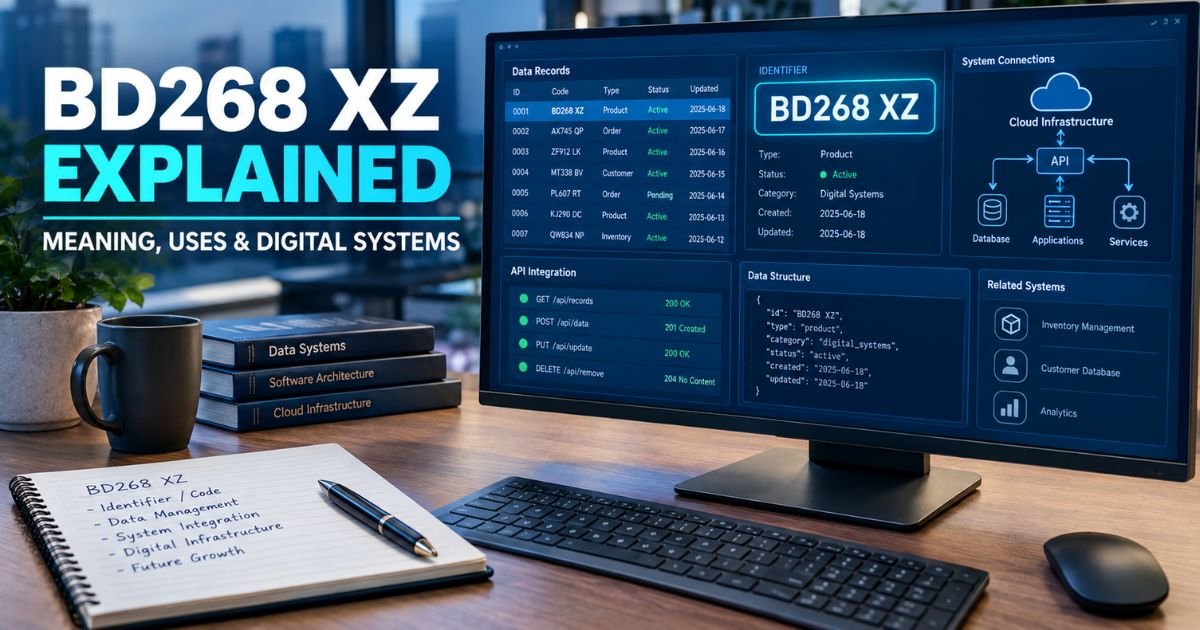
BD268 XZ Explained Meaning, Uses, Benefits, and Future in Digital Systems
BD268 XZ (also written BD268XZ) is a seven-character code made of two letters, three digits, and two more letters. Searches in late October 2026 turned up no manufacturer, standards body, or official documentation that defines it. Plenty of websites publish articles on its “meaning,” but they disagree with each other. Some call it a generic identifier, others a firmware tag, others a smart-home module.
This article sets out what can and can’t be said about the code, helps you work out what your copy of it means, and explains how identifiers like it work in databases, APIs, and cloud systems. When the article talks about uses, benefits, and limits, it means identifiers of this style in general. It doesn’t mean a verified BD268 XZ system, because none has been established.
What Is BD268XZ? Understanding Its Meaning and Purpose
On the page, the facts are simple. The string is seven characters long, usually written in lowercase, in the pattern letter-letter-digit-digit-digit-letter-letter. Whether you type a space in the middle or not, it’s the same string.
What it refers to is a different matter, and no verified public answer exists. Codes of this shape are usually labels. Their job is to point to exactly one thing, such as an order, a device, a batch of goods, a software build, or a database record. But the thing this particular code points to depends entirely on whoever issued it. A code can’t tell you its own meaning.
For that reason, the rest of this article uses a working convention. When it says “a code like this,” it means a short alphanumeric identifier of this style, used as an illustration. Nothing in it should be read as a claim about a real BD268 XZ product or system.
Is BD268 XZ a Recognized Technology or Digital Identifier?
There’s no evidence that it is. Nothing found describes it as a standard, a published product, or a documented software tool. Recognition would normally leave a trail: a specification, a manufacturer page, a registry entry, a repository, or a distributor listing. For this string, that trail hasn’t turned up.
What Can Be Verified About BD268 XZ?
As of late October 2026, the picture looks like this:
| Topic | What can be said | What can’t be said |
| Definition | The string is seven alphanumeric characters | That it has an official or universal meaning |
| Source | Searches found no authoritative issuer or documentation | Who created, owns, or maintains it |
| Function | Codes of this style typically serve as labels | What this specific code labels |
| Third-party articles | Several exist, and they contradict each other | That any of them is based on a primary source |
| The “XZ” part | “xz” is also the name of a compression format, which is unrelated | That the two have any connection |
Distributors also list part numbers with similar-looking formats. Resemblance proves nothing, because many unrelated systems use similar shapes. This is a snapshot, so repeat the search yourself if you’re relying on it. A source could appear later.
Possible Interpretations of the BD268 XZ Code
If you’ve come across this string, the useful question is what it means where you found it. These are common kinds of codes it could be. They’re possibilities, not findings, and nothing here suggests which one is likelier.
| Kind of code | Where you’d typically see it | How to confirm |
| Reference or order number | Receipts, emails, tickets, tracking pages | Match it against the document or account it came from |
| Model or part number | Product labels, packaging, spec sheets | Compare with the maker’s or seller’s product pages |
| Batch or lot number | Packaging, warranty or recall notices | Check the maker’s lot-lookup or support page |
| Firmware or build tag | Settings screens, update logs, error messages | Check the vendor’s release notes or support site |
| Request or session ID | Error messages, server logs, support chats | Ask the service’s support team |
| Username or account handle | Profiles, forums, game or app accounts | Look it up on the platform itself |
Here’s how to narrow it down:
- Note exactly where the code appeared and what surrounded it. Labels such as “Model,” “Lot,” “Ref,” or “Build” often settle the question.
- Look at the object or document itself: the printed label, the packaging, the “About” screen, the original email.
- Search the exact string in quotation marks together with a brand, retailer, or software name from the same context.
- Contact the manufacturer, seller, or service that produced it, and quote the code and where you saw it.
- If it appeared in an order, delivery, or account, search your own records for it.
- If it arrived in an unexpected message, link, or attachment, don’t click or reply. Verify through the organization’s official website or phone number.
If a search returns only generic explainers that guess at its meaning, treat that as no answer, not a confirmation.
Why Its Format Alone Does Not Establish Its Meaning
Letters and digits in a short string is one of the most common shapes in computing. The same seven-character pattern could be a stock-keeping unit at one retailer and a discount code at another. Neither would be related to the other.
Meaning comes from the issuer and the context, not from the characters. There’s no universal registry that translates arbitrary strings into meanings. It helps to separate a value from a format. A value is one specific string. A format is the rule that generates many values of the same shape. Seeing a value tells you little about the rule behind it, or who applies that rule.
That’s why sites that only look at the string end up guessing, and why their guesses conflict.
Read More About : 55+ MiloMagazine.co.uk USA Website Review: Content, Credibility, and SEO Opportunities
Why BD268XZ Matters in Modern Technology
The code’s own importance isn’t established. The need for identifiers like it is.
Without a unique label, a system can’t reliably tell two similar items apart, such as two customers named the same, or two orders for the same product. Without a shared label, two systems can’t agree they’re talking about the same item. That’s why a parcel has a tracking number, a purchase has an order number, and a support agent will ask you to quote a ticket reference.
Unexplained codes surface for the same reason. They turn up in logs, listings, labels, and error messages because software needs a precise handle even when humans don’t. They’re meant for machines first, so they often look meaningless to the rest of us.
Key Applications of BD268XZ in Digital Systems
The uses below describe what identifiers of this style do in practice, not what this specific string does.
BD268XZ in Database Management
A database table needs a way to single out each row. That’s the job of a primary key. Other tables then refer to the row by storing its key as a foreign key, and the database can enforce referential integrity, which means it refuses to let a record point at something that doesn’t exist.
This is how an application assigns codes to database records. An order gets its key when it’s created, and its payments, shipments, and support tickets all hold that same key. The mapping between a real-world thing and its record is only as reliable as the key’s uniqueness. Keys that appear in web addresses also need care, which comes up again in the security section.
BD268XZ in APIs and Backend Systems
APIs use identifiers to retrieve resources. A request to fetch order 48213 is really a request for the record that carries that ID. Beyond resources, systems stamp each incoming request with a request or trace ID. A shared trace ID follows one action across many services, so developers can collect scattered log lines into a single story. Partners can quote the same ID when they report a problem.
Some APIs also use idempotency keys, which let a client retry a request without accidentally creating a duplicate.
BD268XZ in Cybersecurity
Identifiers help with security work. Audit logs record which ID did what and when, and sessions are tracked by session identifiers. A session ID must come from a secure random generator, because a predictable one can be guessed.
The main risk is identifier enumeration. If invoice pages are addressed by consecutive numbers, a curious user can simply try the next one. OWASP’s well-known list of web application risks has long included broken access control for exactly this reason. Unpredictable IDs make casual guessing harder, but they aren’t an access control mechanism. The system still has to check who’s asking, on every request. Treat identifier security risks as a reason to add access checks, not as a reason to trust obscurity.
BD268XZ in Cloud Computing
Cloud platforms create and retire machines, storage objects, and network resources constantly. Each needs a stable label so it can be billed, monitored, and cleaned up. Often, the provider assigns these labels. When teams generate their own across several regions and services, they usually can’t rely on one central counter, which shapes the format they pick. That design question gets its own section below.
BD268XZ in Artificial Intelligence
Machine-learning work produces datasets, experiment runs, trained models, and evaluation results. Labeling each with a unique ID or version lets teams answer a basic question: which data trained which model? That supports data traceability and makes results reproducible. It also lets automated pipelines select the correct file without human help.
Read More About : TechNewsOutlets.Com USA Review Facts Benefits and Risks In 2026
How BD268XZ Works: A Step-by-Step Guide
The steps below describe the general lifecycle of an identifier, from design to retirement, which is the core of identifier lifecycle management. They don’t document any real BD268 XZ system.
Defining the Structure and Format
A format rule fixes the length, the permitted characters, any prefix, and whether case matters. Teams write these down as an identifier schema so everyone generates and validates codes the same way. Practical choices matter here. Mixed case causes mistakes when people read codes aloud, and characters such as zero and the letter O are easy to confuse.
Take the pattern of the string itself as an illustration: two letters, three digits, two letters. With lowercase letters only, that allows 26 × 26 × 10 × 10 × 10 × 26 × 26, or 456,976,000 different values. Allow any lowercase letter or digit in all seven positions and the total is 36 to the seventh power, about 78.4 billion. Capacity grows quickly with length, which is why length is the first thing to settle.
Generating a Unique Identifier
Unique identifier generation generally follows one of four approaches:
- Counters. Each new item takes the next number. This is simple, but it needs one place to keep count.
- Random generation. Values come from a random source. Anything that must resist guessing needs a cryptographically secure one, because weak randomness lowers entropy and makes both guessing and collisions easier.
- Deterministic generation. The same input always produces the same output, for example by hashing or by deriving a value from a namespace and a name. This suits cases where two systems must independently arrive at the same ID for the same thing.
- Time-based or hybrid. Part of the value comes from the clock and the rest from randomness, so new values sort roughly in creation order.
Assigning BD268XZ Within a System
Assign the identifier when the entity is created, and let one component own that job: the application, the database, or a dedicated service. Don’t edit it afterwards. Other tables, logs, and partner systems may already point to it, and changing it breaks those links.
Storing and Managing Data
Store the code in its own column, enforce uniqueness with a database constraint, and index it so lookups stay fast. Validate the format before a value is accepted. The costs and tuning advice come later.
Tracking and Monitoring System Activity
Once every item has an ID, searching for one code pulls up its whole history across logs and tables. A support agent can find a lost order from its reference in seconds, and an auditor can follow one action from start to finish. The goal is data traceability, and it’s the practical payoff of everything above.
BD268 XZ vs. Established Digital Identifier Formats
One clarification first. A single string can’t be compared with a format, because a format is a rule and a string is one result of a rule. The useful comparison is between short, human-readable alphanumeric codes of this style and the established formats developers actually choose from.
| Format | Typical size | Easy for people to read? | Needs central coordination? | Sorts by creation time? |
| Short custom code (like this one) | Around 6–10 characters | Yes | Often, to check for collisions | Not unless designed to |
| Auto-increment integer | 4–8 bytes | Yes | Yes, a single counter | Yes |
| UUID version 4 | 128 bits | No | No | No |
| UUID version 7 | 128 bits | No | No | Yes |
| ULID | 128 bits, 26 characters | Somewhat | No | Yes |
| Snowflake-style ID | 64 bits | No | Needs machine or worker assignment | Yes |
Support for each format varies by database product and version, so check your own platform’s documentation.
BD268 XZ vs. UUIDs
A UUID is a 128-bit identifier, normally written as 36 characters including hyphens. The current specification is RFC 9562, published in 2024, which replaced the older RFC 4122 and added time-ordered versions such as version 7. Version 4 is almost entirely random, while version 7 starts with a timestamp.
The trade-off is readability against safety. A short custom code is easy to read aloud and type, but it has far less room, so collisions become a real concern sooner. A UUID is awkward for humans, but you can generate it anywhere without coordinating with anyone.
So when should you use a UUID instead of a custom code? A UUID fits when many services create records independently, when nobody will type the value, or when you can’t afford a central uniqueness check. A short code fits when people have to read it, say it, or write it down, such as an order reference on a receipt. Many systems use both: an internal key for the database and a short public reference for people.
Differences Between Identifiers, Reference Codes, and Authentication Credentials
These three are easy to mix up:
- An identifier names a thing, such as a record, device, or session.
- A reference code is a human-facing handle for an identifier, such as the number on your receipt.
- An authentication credential proves who you are or what you’re allowed to do, such as a password, token, or API key.
The distinction matters because they can look alike. An API key is also an alphanumeric string. Yet identifiers aren’t built to stay secret. They show up in web addresses, logs, emails, and screenshots shared with support, which is why identifiers should not be used as passwords.
The same logic answers whether a code’s format proves it’s authentic. It doesn’t. Anyone can produce a string in any format. Authenticity comes from confirming with the issuer, or from cryptographic proof such as a digital signature. If an unfamiliar code arrives unexpectedly, check it through the organization’s official channel before acting on it.
Read More About : CracksTube.com Review: 7 Key Facts on Safety & Features (2026)
Choosing an Appropriate Identifier Format for a Digital System
There’s no universal best choice. Weigh these factors:
- Scale. How many records will exist, and how fast do they grow?
- Audience. Will people read or type the value, or is it purely internal?
- Where it’s created. One database, or many services and regions?
- Privacy. Sequential IDs can reveal how many records exist and how quickly they grow. Time-ordered IDs can reveal when something was created. So yes, an identifier can reveal sensitive information.
- Sorting and performance. Do you want records ordered by creation time?
- Size and compatibility. What do your database and partners support?
A few rules of thumb follow. If one database creates everything and nobody sees the IDs, an integer may be enough. If many services create records independently, consider a UUID or another coordination-free format. If humans must handle the value, add a short reference alongside the internal key.
Key Benefits of Using BD268XZ
These are benefits of a well-designed identifier scheme, not of this particular string.
Improved Scalability and Flexibility
Formats that can be generated without a central counter let new servers, regions, and teams join without redesign. They also make it easier to merge datasets from different sources. Capacity is still finite, though, and it depends on length. A short code scales less far than a 128-bit one.
Better Data Organization and Management
When each fact lives in one place and everything else refers to it by ID, you avoid keeping duplicate copies of the same information. That’s the idea behind data normalization. Consistent references between records mean joins work, duplicates are easier to spot, and reports rest on one version of each fact.
Enhanced Security and Traceability
Hard-to-guess IDs make casual snooping harder, and audit trails show who did what. Both help, but neither replaces access control, as covered in the security section above.
Potential Performance Improvements
Databases generally keep indexes in sorted order. Time-ordered keys tend to add new entries near the end, while fully random keys scatter them. That can make time-ordered formats cheaper to write in some workloads. The effect depends on the database, the table size, and the access pattern, so test with data that resembles your own before deciding.
Read More About : Afextop.com Review: Features, Categories, Benefits, and Safety Guide (2026)
Challenges and Limitations of BD268 XZ
Each benefit above has a cost. Best practices for handling these follow in the next section.
Implementation Complexity
The code is short, but the decisions behind it are not. Teams need to agree on format, ownership, validation, and migration plans early. Changing them after launch means touching every system that stores or sends the value.
Data Storage and Indexing Requirements
Bigger keys cost more space. A UUID takes 16 bytes in binary form, while a standard big integer takes 8. Because every index on a table repeats the key, the difference multiplies. Text-based codes are generally larger than their numeric equivalents. Fully random keys can also spread inserts across the index, which may slow writes on large tables. How identifier formats affect database performance depends on the platform, so measure on realistic volumes.
Integration With Existing Systems
Older systems often expect plain integers, and swapping in a new format can break reports, integrations, and partner feeds. Identifier migration strategies usually keep the old ID as an alias, add a mapping table, and cut over in stages to preserve backward compatibility.
Migrations create their own conflicts. If two systems each used 1001, 1002, and 1003 for different customers, merging them produces clashes. Namespaces help: a prefix or separate scope for each source keeps otherwise identical values apart.
Duplicate Identifiers and Data Integrity Risks
If two records share an identifier, one can overwrite the other, a customer can see someone else’s receipt, or referential links can point at the wrong record.
Collision probability rises faster than most people expect, a pattern known as the birthday problem. Suppose codes are drawn at random from all 78.4 billion possible seven-character lowercase-and-digit strings. After roughly 330,000 codes, the chance that at least two match is already about even. That number is small for many businesses. The takeaway is that random short codes need a uniqueness check, and longer formats need far fewer worries.
Best Practices for Implementing BD268XZ
This is general guidance, and the right choices depend on your system.
Maintain a Consistent Format
- Write the rule down: length, characters, case, any prefix.
- Validate every incoming value against it, so malformed codes never reach the database.
- Use one format for one purpose, instead of mixing styles in the same column.
Use Appropriate Database Indexing
- Index the identifier column from the start.
- Load a realistic volume of test data before launch and watch how inserts and lookups behave.
- If writes slow down with random keys, consider a time-ordered format.
Prevent Duplicate Identifiers
- Enforce uniqueness with a database constraint, because application checks alone can miss rare clashes.
- If a clash occurs, generate a fresh value and retry.
- Keep enough length and randomness that clashes stay rare, and use namespaces when merging data from separate sources.
Monitor System Performance and Reliability
- Track insert time, index size, and error rates over time.
- Alert on failed lookups and on constraint violations, since both can point to bad data.
- Review the trends regularly, because slow drift is easier to fix early.
Read More About : 20xBusiness.com Review: 7 Key Facts About Its Features, Credibility, and Business Guides
The Future of BD268XZ in Emerging Technologies
Nothing is known about a roadmap for the string itself. The points below are about where identifiers in general appear to be heading, and they’re interpretation, not prediction.
Cloud Computing and Distributed Systems
In a distributed database architecture, many nodes create records at once, and a single central counter becomes a bottleneck. That’s driving interest in coordination-free, time-ordered formats. RFC 9562 gave UUID version 7 a formal specification in 2024, which may encourage wider adoption.
AI-Driven Automation
As pipelines generate more datasets, runs, and outputs automatically, the need to label and trace each one grows with them. Automated checks that flag missing or repeated labels are a plausible development, though that’s speculation.
Potential Blockchain Applications
Blockchains already identify transactions with cryptographic hashes, so they don’t need a second naming layer for on-chain items. A stable identifier could link off-chain records, such as documents or invoices, to a chain entry. That appears to be a niche pattern today.
Internet of Things (IoT) Integration
Connected devices need identifiers that survive repairs and ownership changes, and small devices have little memory to spare. That favors compact formats and puts a premium on schemes that stay unique across manufacturers. Many device-identification schemes already exist, so any new code would need to fit alongside them.
Common Myths and Misconceptions About BD268XZ
Is BD268XZ Just a Random Code?
You can’t tell from the characters alone. A string can look random and follow strict rules, or look structured and be random. What it represents depends on whoever generated it, as covered earlier.
Does BD268XZ Have Practical Applications?
Identifiers of this kind do, as the applications section shows. Whether this particular string has any use is unverified, and only its issuer could confirm one.
Is BD268XZ Difficult to Implement?
There’s nothing to implement for a string that isn’t a verified system. For identifier schemes in general, small setups are manageable, and the hard parts are agreeing on rules and migrating existing data.
Read More About : Methatreams Explained: Meaning, Safety Risks, Legality and Sports Streaming Alternatives in 2026
Frequently Asked Questions
What Does BD268XZ Mean?
No verified public meaning exists. Its meaning depends on where the code came from, so check its source using the steps above.
What Is BD268XZ Used For?
That’s unverified. Codes of this style generally label records, items, sessions, or requests, but only the issuer of this one can say what it labels.
Is BD268XZ a Software Tool or a Digital Identifier?
There’s no evidence it’s a software tool, and claims that it’s a hardware or smart-home module are unsupported. The most defensible description is an unverified alphanumeric code of the type often used as an identifier.
What Are the Main Benefits and Limitations of BD268XZ?
For the string itself, nothing is established. For identifier schemes of this kind, the benefits are clear naming, traceability, and easier data merging. The limits are setup effort, storage cost, integration work with older systems, and the need to manage collisions.
Conclusion
The main takeaway is simple. This code has no verified public meaning, and its format can’t reveal one. What it means for you depends on where you found it.
Start with the context: the label, document, device screen, or message it came from. Then check with the issuer, whether that’s the manufacturer, the seller, or the service. If it arrived unexpectedly, confirm through an official channel before you click or reply.